
Stop Asking Where to Start With AI. Ask This Instead (+The 8 Types of Work)
Sorting From the Wrong Shelf
The keynote ends. The house lights come up.
The emcee opens the floor for questions, and a hand goes up near the back.
I already know what's coming. It happens at every conference, in every city, in every industry. The wording shifts, but the question never does.
““How do I know where to start with AI?””
I used to think this was a technology question, but I now know it isn't. The person asking usually has access to more AI than they know what to do with. Copilot sitting in their inbox. ChatGPT on their phone. Claude in their Chrome.
The trap comes with that question is that we start to sort by tool, not the problem. We’re asking “What can Claude/ChatGPT do?” or “Where could we use agents?” and then go hunting for problems that fit the answer.
That's like walking the aisles of Home Depot, picking up each tool, and asking what it's capable of – as you wrestle with your house problems.
Wait, what? You'd never do that, right?
Of course not. Instead, we start with the job - like a rotting deck or leaky faucet (or in my case – my garden full of weeds).
By focusing on the problem, that naturally paves the way for the right solution.
What we’re actually asking is more specific:
““Which technology belongs with which problem?””
Believe it or not, the problems we have with work are actually pretty similar.
After two years of running AI enablement sessions with leadership teams, we've found that the work on your plate falls into eight types.
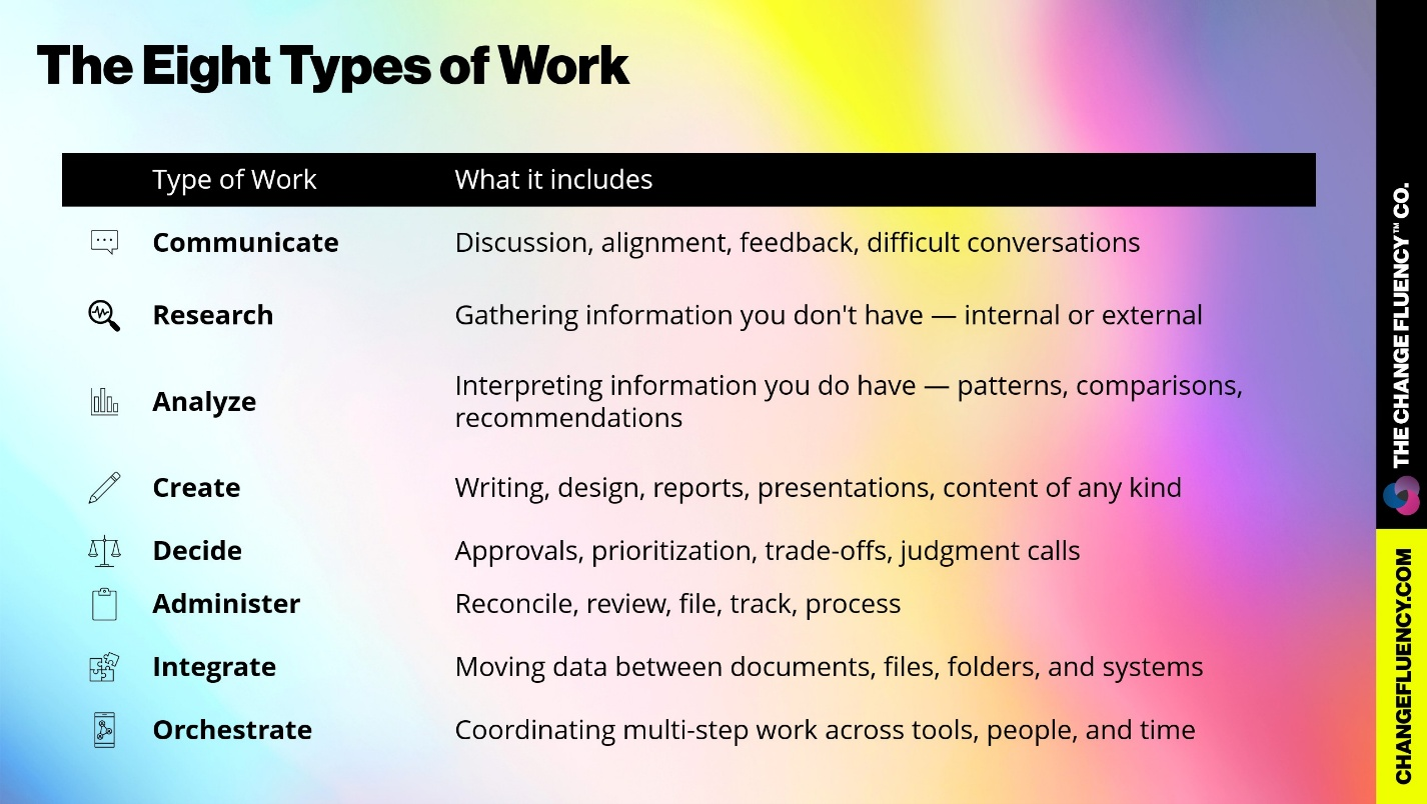
The Eight Types of Work
Communicate. Research. Analyze. Create. Decide. Administer. Integrate. Orchestrate.
That's the whole taxonomy.
· Your daily stand-up? Communicate.
· Your market research report? Research. Analyze.
· Your new membership campaign? Create. Analyze. Decide.
Try it with your calendar – how would you tag each invite from yesterday?
Do you find yourself spending too much time on administration? Something else?
Once you name the work, the technology picks itself
Here's where the conference question gets its real answer. For every type of work, there are only four honest options:
1. Generative AI (ChatGPT, Claude)
2. Agentic AI (e.g. Claude CoWork, OpenClaw, Make, N8N)
3. Traditional automation (e.g. Robotics Process Automation)
4. No technology at all.
Here’s a matrix that may help you figure out what the right solution is to your problem:
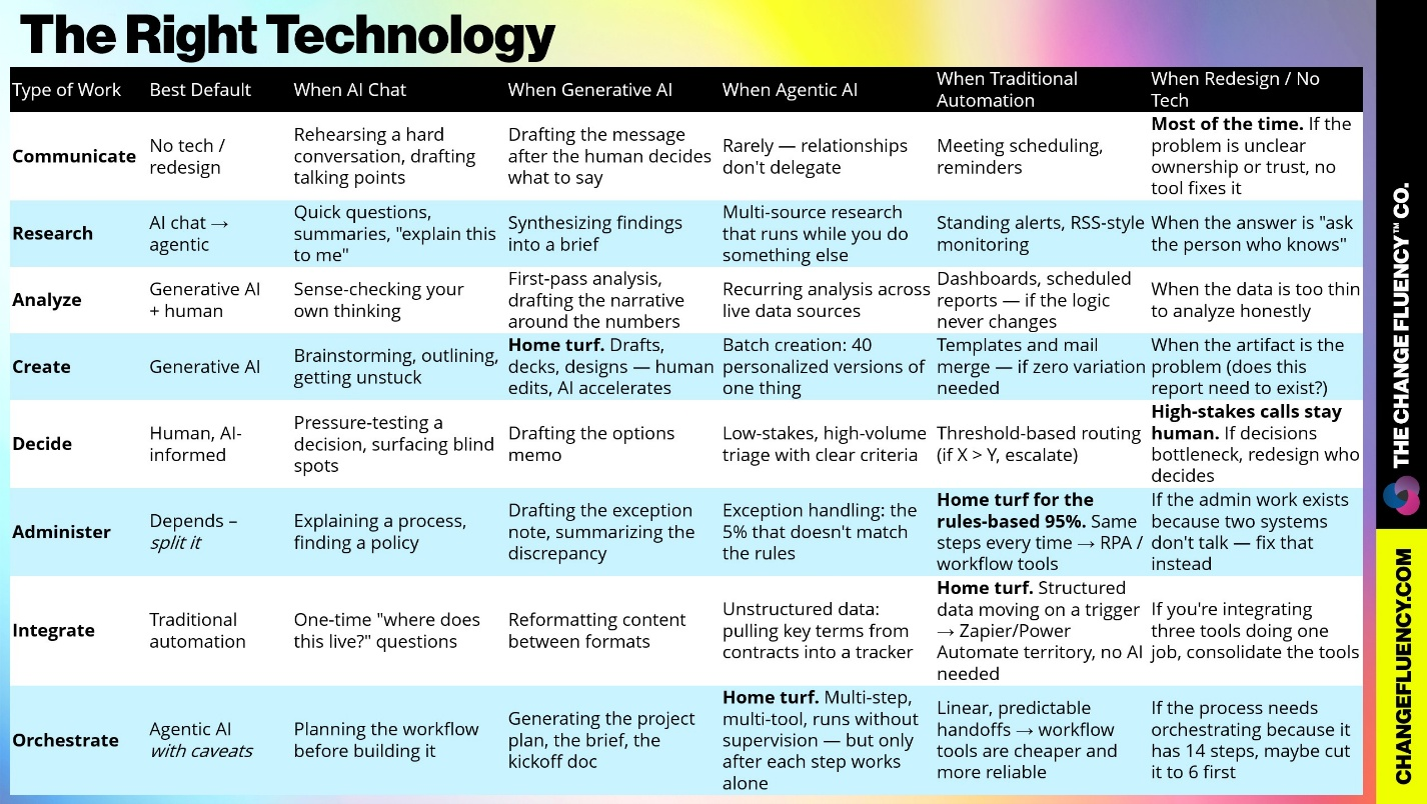
Matching the Right Tech to the Right Problem
Try it out with one piece of your work
Pick a usual suspect on your task list, something that you do regularly, but probably shouldn’t doing. For example, maybe you run a monthly reconciliation of credit card statements and summarize it into a report. Can you move from administer and integrate to building an AI Agent that can do it for you?
If you spend 30 minutes on that task a week and automate it, you could save 26 hours this year.
The conversation is harder than the technology
Here’s what actually happens when you bring this to your team: the objections arrive before the framework does.
· Time: “I don't have time to learn another tool.”
· Fear: “AI is coming for my job.”
· Skepticism: “It's all hype.”
· Lack of Trust: “I don't trust it. It makes things up.”
Four objections: time, fear, skepticism, trust. Every team has at least one of each. A trap we may fall into is is arguing with them.
Rather than arguing with the objection, how might we ask better questions?
Here’s a Leadership Conversation Guide to help you get started:
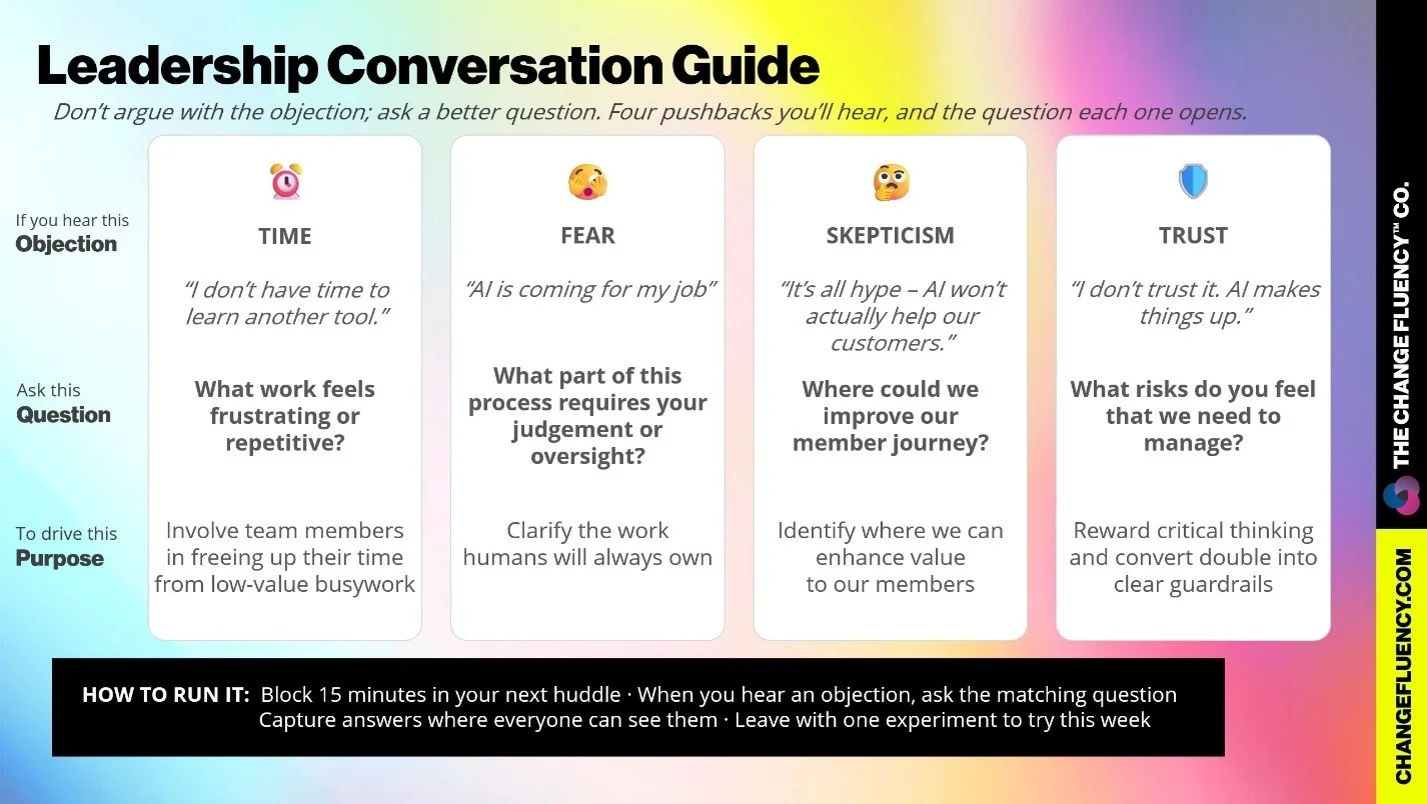
When someone says they don't have time, ask what work feels frustrating or repetitive. You've just recruited them into freeing up their own week.
When someone is afraid for their job, ask which part of the process requires their judgment or oversight. You've just clarified the work humans will always own.
When the skeptic says AI won't help your customers, ask where you could improve the member journey. Now they're identifying value instead of blocking it.
When someone doesn't trust it, ask what risks they feel you need to manage. Their critical thinking just became your guardrails.
Run it in your next huddle. Block 15 minutes. When you hear an objection, ask the matching question. Capture the answers where everyone can see them. Leave with one experiment to try this week.
The next time someone asks “Where do I start with AI?”, nudge them with “What problem would you like to solve first?”
We run this exact session with leadership teams across North America. If you want us to come in and facilitate, book a discovery call with Rich at changefluency.com. If you'd rather run it yourself, the playbook and supporting materials are available here for you to download.
Jay Kiew is a change navigation strategist, keynote speaker, and author.
